Showing posts with label software. Show all posts

Friday, December 28, 2012

The Secret History of Lambda

Being a bit of an origins nut (I always want to know how something came to be or why it is a certain way), one of the things that always bothered me with regard to Lisp was that no one seemed to talking about the origin of lambda in the lambda calculus. I suppose if I wasn't lazy, I'd have gone to a library and spent some time looking it up. But since I was lazy, I used Wikipedia. Sadly, I never got what I wanted: no history of lambda. [1] Well, certainly some information about the history of the lambda calculus, but not the actual character or term in that context.

Why lambda? Why not gamma or delta? Or Siddham ṇḍha?

To my great relief, this question was finally answered when I was reading one of the best Lisp books I've ever read: Peter Norvig's Paradigms of Artificial Intelligence Programming: Case Studies in Common Lisp. I'll save my discussion of that book for later; right now I'm going to focus on the paragraph at location 821 of my Kindle edition of the book. [2]

The story goes something like this:
  • Between 1910 and 1913, Alfred Whitehead and Bertrand Russell published three volumes of their Principia Mathematica, a work whose purpose was to derive all of mathematics from basic principles in logic. In these tomes, they cover two types of functions: the familiar descriptive functions (defined using relations), and then propositional functions. [3]
  • Within the context of propositional functions, the authors make a typographical distinction between free variables and bound variables or functions that have an actual name: bound variables use circumflex notation, e.g. x̂(x+x). [4]
  • Around 1928, Church (and then later, with his grad students Stephen Kleene and J. B. Rosser) started attempting to improve upon Russell and Whitehead regarding a foundation for logic. [5]
  • Reportedly, Church stated that the use of x̂ in the Principia was for class abstractions, and he needed to distinguish that from function abstractions, so he used ⋀x [6] or ^x [7] for the latter.
  • However, these proved to be awkward for different reasons, and an uppercase lambda was used: Λx. [8].
  • More awkwardness followed, as this was too easily confused with other symbols (perhaps uppercase delta? logical and?). Therefore, he substituted the lowercase λ. [9]
  • John McCarthy was a student of Alonzo Church and, as such, had inherited Church's notation for functions. When McCarthy invented Lisp in the late 1950s, he used the lambda notation for creating functions, though unlike Church, he spelled it out. [10] 
It seems that our beloved lambda [11], then, is an accident in typography more than anything else.

Somehow, this endears lambda to me even more ;-)


[1] As you can see from the rest of the footnotes, I've done some research since then and have found other references to this history of the lambda notation.

[2] Norvig, Peter (1991-10-15). Paradigms of Artificial Intelligence Programming: Case Studies in Common Lisp (Kindle Locations 821-829). Elsevier Science - A. Kindle Edition. The paragraph in question is quoted here:
The name lambda comes from the mathematician Alonzo Church’s notation for functions (Church 1941). Lisp usually prefers expressive names over terse Greek letters, but lambda is an exception. Abetter name would be make-function. Lambda derives from the notation in Russell and Whitehead’s Principia Mathematica, which used a caret over bound variables: x̂(x + x). Church wanted a one-dimensional string, so he moved the caret in front: ^x(x + x). The caret looked funny with nothing below it, so Church switched to the closest thing, an uppercase lambda, Λx(x + x). The Λ was easily confused with other symbols, so eventually the lowercase lambda was substituted: λx(x + x). John McCarthy was a student of Church’s at Princeton, so when McCarthy invented Lisp in 1958, he adopted the lambda notation. There were no Greek letters on the keypunches of that era, so McCarthy used (lambda (x) (+ x x)), and it has survived to this day.
[3] http://plato.stanford.edu/entries/pm-notation/#4

[4] Norvig, 1991, Location 821.

[5] History of Lambda-calculus and Combinatory Logic, page 7.

[6] Ibid.

[7] Norvig, 1991, Location 821.

[8] Ibid.

[9] Looking at Church's works online, he uses lambda notation in his 1932 paper A Set of Postulates for the Foundation of Logic. His preceding papers upon which the seminal 1932 is based On the Law of Excluded Middle (1928) and Alternatives to Zermelo's Assumption (1927), make no reference to lambda notation. As such, A Set of Postulates for the Foundation of Logic seems to be his first paper that references lambda.

[10] Norvig indicates that this is simply due to the limitations of the keypunches in the 1950s that did not have keys for Greek letters.

[11] Alex Martelli is not a fan of lambda in the context of Python, and though a good friend of Peter Norvig, I've heard Alex refer to lambda as an abomination :-) So, perhaps not beloved for everyone. In fact, Peter Norvig himself wrote (see above) that a better name would have been make-function.


Saturday, October 13, 2012

GIMP 2.8 and the Taming of Two Decades' Graphics Habits

At long last, I find myself in a 100% comfort zone with the GIMP. As a user, it's been a long road to get here ... I can't even imagine what the development teams have experienced over the past 16 years. Regardless, I am infinitely grateful for their efforts over that time, their hard work to bring the world a completely free, open source application for incredibly sophisticated image manipulation, drawing, and even painting.

I'll provide some more details on my experiences with GIMP 2.8, but first... a romp through the past!

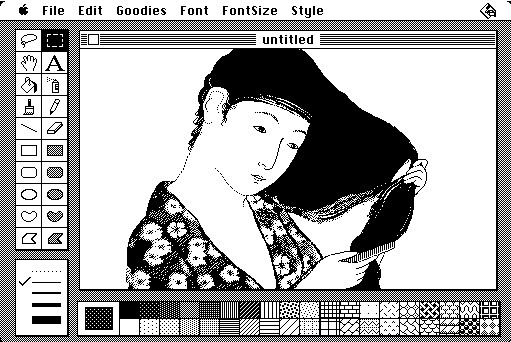
I've been using graphics programs since my first exposure to the Macintosh Plus and SE machines in the late 1980s, where the head of the science department at Bangor High School often found himself without access to his machine (yeah, thanks to me...). As much as a science geek as I was, it was actually the graphics programs to which I was addicted. In particular, I was obsessed with using MacPaint to draw -- pixel by pixel -- a dithered bitmap of a photograph leaning next to the monitor.

About 6 or 7 years later, I was at it again doing graphics work on a non-profit's Mac (running System 7) with Photoshop 3.0 -- my first exposure to this software. It was absolutely mind-blowingly awesome what Photoshop enabled one to do with digital images. I was consumed. If I was awake, I was at the computer, creating something whacky from scratch or morphing something old into a new form. Though the work that I had done was focused on graphics for HTML and getting into the nascent field of "web design," some of my efforts ended up getting published as illustrations for a book.

I continued doing graphics as part of my work (in some form or another) from then on, usually borrowing a friend's machine in order to use Photoshop (which I could not afford). Despairing of not having my own copy of the software,  I would often try out other drawing, painting, and image manipulations applications. Without fail, none would ever measure up to the power and even more, the usability, of Photoshop.

It wasn't too much after this that I got involved with Linux and open source software. As for many from that time, my life has not been the same since. But those early years were painful. My first distro (Slackware), I had to manually hack the ethernet drivers in C just to get connected to the network using my particular hardware. Regardless, Linux was all I could think about; it was all I wanted to use.

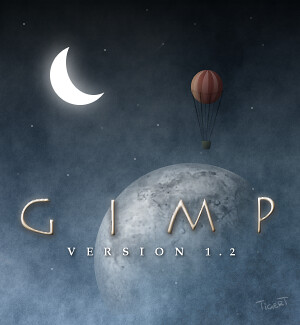
Desperately hungering for a Photoshop-like experience on Linux, I searched HotBot on a regular basis, and finally discovered GIMP. Based on a quick glance at the now-historic splash screens, it looks like my first use of the GIMP started after the 1.0 release, though I didn't start using it more regularly until 1.2 (which had my favorite GIMP splash screen to date).

Despite my hopes and the best efforts of an amazing development team, the GIMP infuriated me. What took one step in Photoshop usually took about 5 steps in the GIMP. The user interface was anti-intuitive, and seemed to be built by folks with an intimate knowledge of the underlying API and reflected this far too well.

With each major release of the GIMP, I would find myself downloading and installing it, but only actually using it a handful of times. Ultimately, I'd run crying back to Photoshop, borrowing a friend's computer or persuading someone to give me an unused copy. The very nature of graphic arts is visual and intuitive... I felt that the GIMP was blocking that natural flow. As a result, I couldn't get anything done in it (and what little I did looked bad).

Year later, while working at Canonical, I had several opportunities to create graphics for various fun projects, gags, or practical jokes. Given the nature of the company's mission, I made sure to do that work using the GIMP. Though the pain of the old days had faded considerably, and GIMP had, by 2008, reached a much higher degree of usability, I still found myself enduring awkward workflow moments on a regular basis and this continued throughout the 4 years of version 2.6's release. However, during that time, an impressive selection of GIMP plugins were created, some of which I came to adore so completely that I would switch from Photoshop to GIMP, just so I could use them on a project. This was a new -- and amazingly welcome -- change for me.

Then, earlier this year, the last few pieces fell into place.

With the release of GIMP 2.8 in May, I have not looked for nor pined over any other sophisticated graphics programs. At long last, the GIMP completely satisfies. The biggest single point of pain for me in 2.6 (given that I was running on Mac OS X most of the time) was the lack of single-window  support. For every UI interaction, I had to click twice -- once to focus on the window, and once to actually perform the given action. It was crazy-making. 2.8 finally released the goodness of single-window mode for GIMP users around the globe. Futhermore, since I have been a layer-using maniac since Photoshop 3.0 and my graphics files tend to reach into the 200 and 300 MB range due to the numbers of layers (and resolution, of course), I have a desperate need to organize the chaos of all those layers. Prior to 2.8, my layer pallet on large projects was almost completely unnavigable. With 2.8, sanity and cleanliness abounds.

And there's more :-) Check out this short list:
  • single-window mode
  • multi-column dock windows
  • increased screen real-estate
  • layer groups
  • Cairo is used for all rendering
  • on-canvas text editing
For more details, you'll want to visit this page.

Oddly, this walk down memory lane and ultimate endorsement of the GIMP relates to MindPool.  I used the GIMP to do all the complicated graphics work for our initial branding, logos, etc. Looking at the results, I'm sure if seems fairly silly and even trivial... but there's a LOT that went into that simplicity :-)

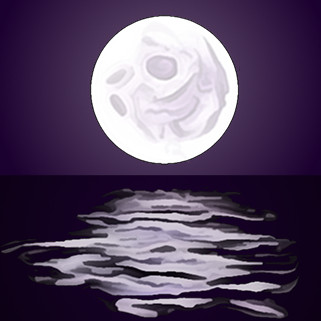
For instance, the shot of the moon is actually taken from a photograph of the moon. It has been passed through multiple filters in order to get just the level of abstract color and shape I was looking for. Similarly for the water, but the settings were actually quite different to achieve the result I was seeking. I think the layer count peaked around 30 in one version of the file.

Another example is the logo that we'll be using for the company's main site. This also took advantage of some plugins (new and old), though mostly it relied upon paths, brush strokes, and mask layers (the latter for the water pool reflection watermarked into the image). The new features in 2.8 made all of that work very easy to do. No longer is the tool interfering with my workflow; rather, it is facilitating it. Working with graphics using open source tools is now an absolute pleasure for me.

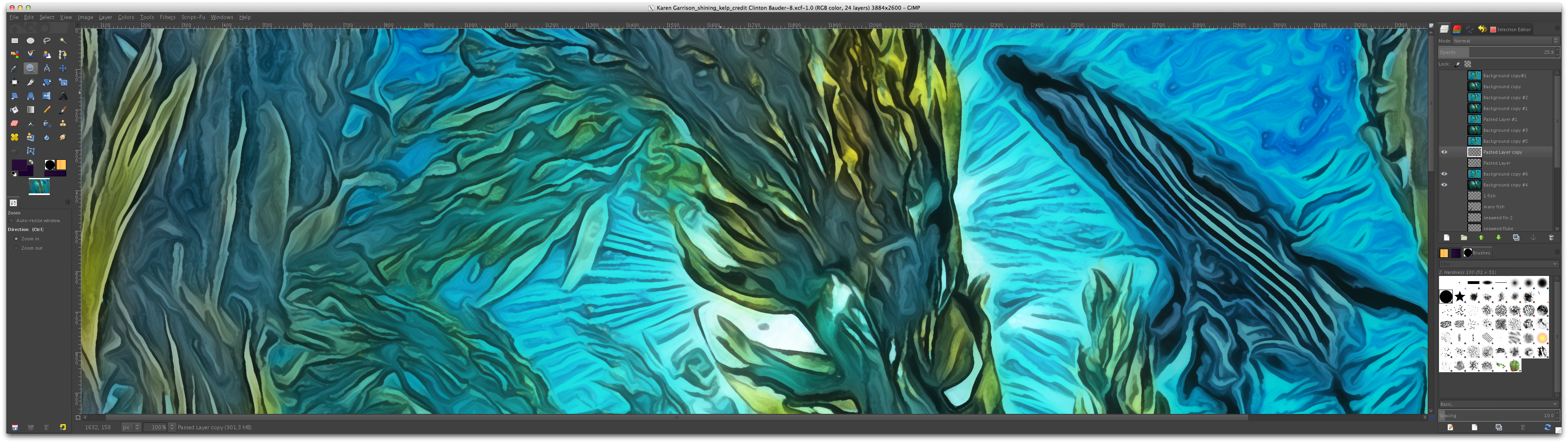
For giggles, I'm including a screenshot of GIMP 2.8 in action, with my single-window mode view stretched across two 27" monitors (full version is here). Graphical editing has never been so clean!

Thanks, GIMP team :-) It's nice to finally be home.

Fun link: For the historically inclined, you might enjoy this quick read about the beginnings of Photoshop and the family that made it all happen :-)

Monday, May 14, 2012

CERN, OpenStack Keep Resonance Cascades at Bay

Tim Bell preparing to get his
OpenStack on
As previously mentioned, there's a growing momentum around ops-oriented participation in the OpenStack community. DreamHost is deeply invested in DevOps, seeing how that's where we're going to be living in a few months! As Simon Anderson, CEO of DreamHost, recently said:
"When we're running a complex fabric of apps on over 5,000 servers across three data centers, we need a lean and nimble approach to software development and operational implementation. Without a DevOps approach, we wouldn't be able to push code into production as fast or as efficiently as we do, and our customers would not be happy! Today's developers demand up-to-the-hour security and performance updates to Internet infrastructure, so we aim to deliver just that with DevOps."
Though expressed in the context of our work, the import of DevOps that Simon's comment generally highlights is going to be increasingly important for nearly anyone running cloud services. 

In particular, I've been following the work of the intrepid folks at CERN. As such, this post is not about DreamHost; rather, it's a mad tale of OpenStack, DevOps, and averting alien invasion.

After countless long-distance phone conversations, a flight to Switzerland, and spending several days buying pints for a security guard in the know (referred to from now on as "Barney"), I've uncovered some profound truths -- Mulder-style -- and have confirmed that the impact of OpenStack at CERN is huge. 

Superficial examinations turn up the usual: CERN's planning slides, nice quotes, discussions of features and savings in time and money. For instance, in a recent email conversation with Tim "Gordon Freeman" Bell at CERN, I learned that 
"The CERN Agile Infrastructure project aims to develop CERN's computing resources and processes to support the expanding needs of LHC physicists and the CERN organisation."
I think these guys have been hanging out with Simon! But once you slip behind the scenes, peek at some of the whiteboards in unattended rooms, or rifle through notes lying about, you see that things are not what they appear. I've included a shot of Mr. OpenStack-at-CERN himself; this was my first clue.

Publicly, he's been working with other teams at CERN to:
  • modernise the data centre configuration tools and automating operations procedures
  • exploit wide scale use of virtualisation, improving flexibility and efficiency
  • enhance monitoring such that the usage of the infrastructure can be fully understood and tuned to maximise the resources available
But privately, it seems that he and his team have been doing much, much more. This was alluded to in a statement made by team member Jan van Eldik: "We expect the number of requests to insert non-standard specimens into the scanning beam of the Anti-Mass Spectrometer to significantly decrease, once automation is in place and everyone is using the standard infrastructure we are setting up."

That isn't to say there haven't been incidents...

Innocuously enough, the current toolchains are based around:
  • OpenStack as a single Infrastructure-as-a-Service providing physics experiment services, developer boxes, applications servers as well as the large batch farm
  • Puppet for configuration management
  • Scientific Linux CERN as the dominant operating system with sizeable chunk of Windows installs
But that second bullet caught my eye, and one of Barney's pub mates confirmed a rumor that we'd heard: the Puppet instances are actually trained headcrabs. The primary training tool? You guessed it, a crowbar. Barney said that the folks from Dell took inspiration from this and developed it further for their OpenStack deployment framework after an extended visit to CERN.

Although Barney hadn't seen any evidence of resonance cascades, there have been minor cross-dimensional disturbances as a result of some "cowboy" activity and folks not following DevOps best practices. This has been kept quiet for obvious reasons, but has led to a small pest problem in some of CERN's older tunnel complexes. As rouge elements are discovered, CERN has been educating transgressors aggressively. (Sometimes they go as far as sending employees to Xen training... or was it Xen training?)

One artist's conception of what success will
look like for OpenStack at CERN
Despite the minor hiccoughs along the way, CERN is aiming for success. (Given the lack of Combine and forced relocation programs, they're already doing better than Black Mesa's Anomalous Materials team.) Plans are in place for an initial pre-production service, OpenStack deployment this year. Following that, they will be moving towards 300,000 virtual machines on 15,000 hosts spread across two data centres by 2015.

The OpenStack community is supporting them in their efforts with fantastic new features, high-quality discussions on the mail lists, and real-time interaction on the IRC channels. In an act of reciprocity and community spirit, operators at CERN have volunteered to contribute back to the OpenStack community with regard to operations best practices, reference architecture documentation, and support on the operators' mail list.

To see how other institutions were taking this news, I spent several days waiting on hold. In particular, Aperture Science could not be reached for comment. However, Ops team member Belmiro Rodrigues Moreira did say that there's an audio file being circulated at CERN of Cave Johnson threatening to "burn down OpenStack" ... with lemons. Given Aperture Science's failure record with time machine development, it's generally assumed to be a prank audio reconstruction. CloudStack developers are considered to be the prime suspects, seeing how much time they have on their hands while waiting for ant to finish compiling the latest Java contributions.

When asked what advice he could give to shops deploying OpenStack, Tim said simply: "Remember, the cake is a lie. Don't get distracted and don't stop. Just keep hacking."

Alyx, explaining to her dad why she loves DreamHost
Couldn't have said it better myself.

In closing, and interestingly enough, one of DreamHost's employees has an uncle who works at the Black Mesa Research Facility. Though his teleportation research team was too busy for an extended interview, his daughter did mention that she is a DreamHost customer and can't wait to use OpenStack while interning at CERN next summer. After all, that's what she uses to auto-scale her WordPress blog (she's in our private beta program).

It's a small world.

And, thanks to Tim and the rest at CERN, a safer one, too.


Saturday, May 12, 2012

Twisted SSH: Rendering a Log-in Banner/MOTD in Conch

A few weeks ago, I pinged my peeps on #twisted asking why the banner for a custom SSH server wasn't rendering properly. After some digging around and some inconsistent results (well, consistently bad results for me), we weren't able to resolve anything, and I had to set the problem aside.

The Symptom
The first thing I had tried was subclassing Manhole from twisted.conch.manhole, overriding (and up-calling) connectionMade, writing the banner to the terminal upon successful connection. This didn't work, so I then tried overriding initializeScreen by subclassing twisted.conch.recvline.RecvLine. Also a no-go. And by "didn't work" here's what I mean:

In both Linux (Ubuntu 12.04 LTS, gnome-terminal) and Mac (OS X 10.6.8, Terminal.app), after a successful login to the Twisted SSH server, the following sequence would occur:
  1. an interactive Python prompt was rendered, e.g., ":>>"
  2. the banner was getting written to the terminal, and
  3. the terminal screen refreshed with the prompt at the top
This all happened so quickly, that I usually never even saw #1 and #2. Just the second ":>>" prompt from #3. Only by scrolling up the terminal buffer would I see that the banner had actually been rendered. Even though I was doing my terminal.write after connectionMade and initializeScreen, it didn't seem to matter.

Discovery!
Some time last week, I put together example Twisted plugins showing what the problem was, and the circumstances under which a banner simply didn't get rendered. The idea was that I would provide some bare-bones test cases that demonstrated where the problem was occurring, post them to IRC or the Twisted mail list, and we could finally get it resolved. 'Cause, ya know, I really want my banners ...

While tweaking the second Twisted plugin example, I finally poked my head into the right method and discovered the issue. Here's what's happening:

  • twisted.conch.recvline.RecvLine.connectionMade calls t.c.recvline.RecvLine.initializeScreen
  • t.c.recvline.RecvLine.initializeScreen does a terminal.reset, writes the prompt, and then switches to insert mode. But this is a red herring. Since something after initializeScreen is causing the problem, we really need to be asking "who's calling connectionMade?"
  • t.c.manhole_ssh.TerminalSession.openShell is what kicks it off when it calls the transportFactory (which is really TerminalSessionTransport)
  • openShell takes one parameter, proto -- this is very important :-)
  • openShell instantiates TerminalSessionTransport
  • TerminalSessionTransport does one more thing after calling the makeConnection method on an insults.ServerProtocol instance (the one I had tried overriding without success), and as such, this is the prime suspect for what was preventing the banner from being properly displayed: it calls  chainedProtocol.terminalProtocol.terminalSize
  • chainedProtocol is an insults.ServerProtocol instance, and its terminalProtocol attribute is set when ServerProtocol.connectionMade is called.
  • A quick check reveals that terminalProtocol is none other than the proto parameter passed to openShell.

But what is proto? Some debugging (and the fact that of the three terminalSize methods in all of twisted, only one is an actual implementation) reveals that proto is a RecvLine instance. Reading that method uncovers the culprit in our whodunnit:  the first thing the method does is call terminal.eraseDisplay.

Bingo! (And this is what I was referring to above when I said "poked my head" ...)

Since this was called after all of my attempts to display a banner using both connectionMade and initializeScreen, there's no way my efforts would have succeeded.

Here's What You Do
How do you get around this? Easy! Subclass :-)

The class  TerminalSessionTransport in t.c.manhole_ssh is the bad boy that calls terminalSize (which calls eraseDisplay). It's the last thing that TerminalSessionTransport does in its __init__, so if we subclass it, and render our banner at the end of our __init__, we should be golden. And we are :-)

You can see an example of this here.

Not sure if this sort of thing is better off in projects that make use of Twisted, or if it would be worth while to add this feature to Twisted itself. Time (and blog comments) will tell.

Epilogue
As is evident from the screenshot above (and the link), this feature is part of the DreamSSH project. There are a handful of other nifty features/shortcuts that I have implemented in DreamSSH (plus some cool ones that are coming) and I'm using them in projects that need a custom SSH server. I released the first version of DreamSSH last night, and there's a pretty clear README on the github project page.

One of the niftier things I did last night in preparation for the release was to dig into Twisted plugins and override some behaviour there. In order to make sure that the conveniences I had provided for devs with the Makefile were available for anyone who had DreamSSH installed, I added subcommands... but if the service was already running, these would fail. How to work around that (and other Twisted plugin tidbits) are probably best saved for another post, though :-)


Monday, January 12, 2009

Python and Rhythmbox


I've got a fairly large collection of digital music on a networked drive, and I access it from multiple machines on the network. I consolidated it 5 years ago when I started using iTunes, and over the past few years picked up about 400 songs from the iTunes store. This is something I avoid now, since Amazon offers songs at higher bitrates and without the crippling, non-Fair Use of DRM. (Apple seems to have recently changed it's policy, though the pain their DRM crap has caused me doesn't make me a very loyal customer.)

Since I started working at Canonical, I've been using Ubuntu for more than just development -- it's my main-use machine. I still use iTunes every once in a while, but my primary media player is Rhythmbox. There are a couple of issues with the old library, though.

Obviously, Rhythmbox can't play Apple's encrypted .m4p files or a couple audio book files I have. What's more, there are about 200 files that iTunes is able to locate but which Rhythmbox cannot (this may be due to the differing case sensitivities of the respective OSs). In order to track all these issues down conveniently, I wanted to export the import errors and missing files as a text file. Sadly, Rhythmbox doesn't have this functionality.

Fortunately, it comes with a Python console :-)

The missing files export was fairly easy, after some digging around and poking at the Python objects:

Try as I might, I was completely unable to obtain similar data for the import errors. After looking at the C code, I was able to determine that though the import errors were treated generally as a media source, due to their nature (not being able to provide the actual media itself), the related meta data was handled differently. Yet I wasn't able to decipher how, exactly.

So, I hopped on their mail list and asked for help :-) After a few quick exchanges, I was pointed in the right direction by one of the developers, who said that I needed to make use of the db object and some constants. After a quick test, this advice resulted in the following:


Note that the shell and rhythmdb objects are exposed by Rhythmbox in Python console sessions.

I now have a complete list of files that either need some file name updates or need to be burned to CD in iTunes and ripped to OGG.

So far, I've been pretty pleased with Rhythmbox. Thanks to their use of Python, I find I'm now becoming somewhat of a fan :-)


Monday, December 08, 2008

The State of Graphs in Python


There is a sad need for standardization of graphs in Python. The topic has come up numerous times on various mail lists, news groups, forums, etc. There is even a wiki page dedicated to the discussion of the topic on python.org. Ach, when will the madness end?

As far as I can tell, Guido van Rossum essentially solved this issue 10 years ago when he published his paper on Python Patterns - Implementing Graphs. The graph representation is a simple dict and he provided a few functions for demonstration purposes. In 2004, UC Irvine professor David Eppstein started making public his Python graph-theoretic efforts (with a functional programming approach). Both of these represent a direct approach that appeals to my aesthetic sense.

Now, after years of tracking the lack of progress made in standardizing graph representations in Python, I've recently had strong need of them. I did some checking around, and found projects that potentially met my needs. Sadly, none of them had the simplicity of Guido's original implementation (and therefore, anticipated speed benefits).

I was looking for graph implementations with no cruft, no external dependencies, no afterthoughts. I need something that balances runtime performance with a usable API, preferably created using PEP-8 (or similar) coding style.

Here's what I found, with some notes that I used to make a decision for my own needs:
  • PADS - David Eppstein's work; functional programming style; very strong math; leaves the implementation of the graph up to the developer-user
  • altgraph - too many utility and special-purpose methods for my taste; uses a custom graph object
  • python-graph - a new implementation; uses its own objects; seems to take the "framework" approach to graph implementation
  • graph - requires the use of custom vertex and edge objects
  • NetworkX - fairly complete; lots of redundant code; covers more than just a graph implementation (I only include it here because it seems to be fairly highly used)
If you know me, then you've guessed what's coming next. Yes, I'm going to contribute to the general chaos and announce yet another graph library. What I hope to accomplish with this is provide a very simple implementation based on Guido van Rossum's approach (dictionary-based) that doesn't consume much memory, can be operated on quickly, and can be used anywhere.

In keeping with this motivation, I've started a new project on Launchpad and named it simple-graph. My initial efforts will be aimed at implementing a dict-based graph per Guido's paper, with the possible inclusion of some of David's functions (updated to operate on a dict object). I will then spend some time taking inspiration from the best of what the other graph libraries have to offer while keeping things simple.

As I stated on the web panel at PyCon 2007, diversity is a good thing; it gives us a rich gene pool from which a full and healthy process of natural selection may occur. Let's hope that the efforts of so many Python programmers eventually lead to the inclusion of a graph object in the Python standard library.


Tuesday, November 11, 2008

Python and Lisp... Again


It seems that Lisp continually comes up in various conversations (virtual and otherwise) in the context of Python. In fact, maybe we could even call such occurances the Python-Church conversations. Well, here it is again.

Earlier this year I started working on a new project: an object-oriented genetic programming library. I had a bunch of experiments I wanted to do, but I needed to assemble parts of programs in order to do it. I had hoped to use Python, but inspecting Python's AST ended up being too much of a hassle. I wanted to distribute, process, and manage evolutionary algorithms/programs across multiple remote Twisted servers, and manipulating permutations of partial programs would be much easier to integrate with Twisted (the target "platform") if the programs themselves could be evaluated and introspected easily with Python.

After some digging around, I eventually settled on using PyLisp, mostly for the simplicity of the code and the fact that it was just a single file. Since it hadn't been maintained since 2002, I decided to roll the original file into the genetic programming code and then apply any changes as-needed, over time.

More recently, I've wanted to use this modified PyLisp on other projects and as a result, I have split it out into it's own project: pyLisp-NG. This naturally led to further code break-out, for a total of three projects:
  • pyLisp-NG - the functional programming (and introspection) component of the original project
  • Evolver - the code that allows one to do Python-based evolutionary programming (string-based as well as source code tree node optimization/search solution discovery)
  • txEvolver - will enable users to distribute genetic programming operations (such as merging parallel generations of computations)
pyLisp-NG was released earlier today and is available for download on PyPI.


Monday, November 10, 2008

txJSON-RPC

Tonight, I just pushed a new version of txJSON-RPC up to PyPI. Let me know if you have problems with this one, as the last one had some issues with setup.py.

The new cool feature in this version is the serialization available to the bundled jsonrpclib module (which doesn't depend on Twisted code, so anyone can use that). txjsonrpc.jsonrpclib now supports Python datetime -> JSON serialization. The date format is the same as that used by xmlrpclib: YYYYddmmTHH:MM:SS.

Enjoy!


Wednesday, August 27, 2008

netaddr Python Library


I recently got several feature requests for my NetCIDR Python library, and in the course of a conversation with one user in particular, I was made aware of the netaddr project. I took some time to explore the code details and was quite impressed: drkjam did a great job. The manner in which he implemented the many features (especially the IP math) was the kind of thing I wanted to do for NetCIDR ... at some point. After about an hour of digging around, testing out the API, and pondering, I decided to retire NetCIDR and encourage my users to migrate to netaddr.

There are a couple more esoteric features in NetCIDR that netaddr currently doesn't have, but we've started talking about adding support for those in netaddr, at which point there will be no need to use NetCIDR.

To facilitate this, I've added a wiki page on the netaddr Google Code project for helping users make the transition from NetCIDR to the netaddr API.


Wednesday, June 25, 2008

Safari 3.1.1 Installer Hosed on OS X 10.5.3

I recently tried updating my Safari to the latest version, only to discover from here and here that Apple seems to have intentionally made this a 10.5.2-only update. I looked in the "Distribution" script and confirmed that this was, in fact, the case. The obvious symptom of this was that the installer told me I couldn't install Safari on any of my drives. Nice.

On those forum posts, I also discovered this great tool: Pacifist. It's been on my backburner list for a while to find a tool that could open up and extract Mac OS X packages, so for that alone I was delighted. When combined with PackageMaker, I was able to create my own installer. Even better.

If this is useful for anyone else, I've put it up here: Safari311UpdLeo_Divmod.pkg. Do note, however, that this installer has no brains: it just puts the files where they should be. It also doesn't check for your system version, so it could potentially really screw things up. Neither I, the Divmod community, nor Divmod, Inc. are responsible in any way if this installer takes your machine to the knacker's yard. However, I am using it on 10.5.3 with no issues (so far).


Saturday, June 21, 2008

txLoadBalancer

Well today was a flurry of activity... pulled an all-nighter whipping a python load balancer into shape after some late-afternoon discussions on #divmod.

At Divmod, we're going to be labbing out some distributed services experiments with twistd servers, and one set of those experiments involves "developer friendly" load balancing. JP suggested that I take a look at how PyDirector works and see if we could use that. Which was actually interesting in a full-circle kind of way: I worked on PyDirector when I was at PBS, ages ago, where I wrote a weighted lb algorithm for it.

Jumping into the code again after a 5-year hiatus was like seeing an old friend :-)

All tonight, I worked on the following branches:
txLoadBalancer 0.9.1 and 1.0.1 are up on PyPI in the usual place.

I did lots of manual functional testing for each branch tonight, but I didn't do any TDD. While I'm still playing with it, I'll probably start adding tests as bugs crop up (BDT), and as it gets more serious I'll go fully into TDD and fill in what's missing at that point.

Tonight's mad rush was actually a great deal of fun. It's been a while since I've had the opportunity to plow through a bunch of code like that, and I enjoyed myself to near exhaustion :-) I don't think I'll be able to get to sleep tonight (er, this morning), due to the endless thinking about all the ways in which I want to use this code, mutate it, and... well, I better leave some surprises for later!

Update: I've edited the links for the latest micro-releases that fixed some issues with setup.py.

Update 2: Thanks to the heads-up in the comments from Kapil, I've patched txLoadBalancer trunk with the changes from Apple (David Reid and Wilfredo Sanchez).


Tuesday, May 27, 2008

Twisted and Divmod: A Cheater's Setup Guide

I've been helping a few folks out on IRC lately. They've wanted to know how to setup Twisted and Divmod without doing any installs, running directly from SVN. They've been in luck, because that's actually how we develop at Divmod :-)

Here are the Cliff Notes (this stuff is available on the wikis, but it's spread out):

Install the dependencies:
pycrypto 2.0
SQLite 3.2.1
PySQLite 2.0
PyTZ 2005m-1
PIL 1.1.6
Get the Divmod code first (we'll get Twisted next):
mkdir ~/lab
cd ~/lab
svn co http://divmod.org/svn/Divmod/trunk Divmod/trunk
Set the Combinator env vars (if you want to persist this, then you'll need to put it in your .profile or shell .rc file):
eval `python ~/lab/Divmod/trunk/Combinator/environment.py`
Have Combinator start "tracking" Divmod and Twisted, thus managing PYTHONPATH for them (note that chbranch will detect that Twisted has not been checked out and will do so automatically):
chbranch Divmod trunk
chbranch Twisted trunk svn://svn.twistedmatrix.com/svn/Twisted/trunk
Get the new project dirs into the env:
eval `python ~/lab/Divmod/trunk/Combinator/environment.py`
Executing the whbranch command should give you the following:
Divmod: trunk
Twisted: trunk
If you start up a Python interpreter, you'll be able to import from twisted, mantissa, axiom, etc.

Update: the instructions have been edited and shortened, thanks to insight from Glyph.


Mantissa: An Alternative to LAMP

I first started drafting this post a few months ago, out of excitement for the work that JP and Glyph have been doing in the Divmod open source stack codebase. I was planning on entering the acronym fray with a title like "*MAP: An Alterantive to LAMP" where *MAP (pronounced "starmap") would be "Any OS, Mantissa, Axiom, and Python." A good friend of mine whose opinion I value said that *MAP was a terrible name, and after chatting about it with Glyph, he commented "Why not keep it really simple? Just say 'Mantissa.'"

And so it is :-)

For those that don't know, Mantissa is the Twisted application server and Axiom is a Twisted-based object database. By virtue of what are called "deferreds," Twisted allows you to write highly concurrent applications. Mantissa -- the Divmod stack (Mantissa entails Python, Twisted, and Axiom because it requires them) -- provides developers a means of scaling their Twisted-based, asynchronous applications. This means that you can go from experiments or prototypes to multi-node production deployments with the same set of tools and code.

As such, this is a direct competitor for LAMP. Here are some questions about that: What is the value of a full stack? Why is an alternative to LAMP good or needed? What is a good alternative?

Stacked Development Value

What does a full stack give us, as developers? From a practical perspective, it:
  • eliminates the overheard involved in setting up a system in preparation for development
  • provides a development toolset
  • provides a context within which design patterns have been established and utilized
In other words, we can do things like pop in a CD, install an OS, have it meet all the software dependencies for our development tasks (since we're talking about LAMP, we mean development for the web), and either know how to build what we need or who to ask that can point us in the right direction. LAMP gives us this and, thanks to OS distributions like Ubuntu, gives it to us cheaply through simple button-pushing.

Do notice, however, that I said nothing about "going live" or "pushing to production"...

An Engineer's Perspective

In a recent conversation, Sean Reifschneider of tummy.com had this to say about LAMP:
"The problem with the LAMP stack is that it's not a solution for the worst case scenarios. It's great for development: you throw it all together and start writing code. It's fairly okay for low-volume production use. But you need to plan for DoS attacks, search engine bot crawls, and spammer email address harvesting. Default LAMP installs fall over under such conditions."
This is a point that bears repeated belaboring: the network is violent and unpredictable. Connectivity can go away at any moment due to causes at pretty much all layers of the OSI model. The best practices for deploying applications in a production environment that keep this in mind are vast and varried. This is the domain of systems experts.

Sean made further comments concerning Google, that App Engine is so great because you write your code and then just throw the whole thing in their grid, and bam! instant scalability, protected by the (hopefully) same mechanisms that protect all of Google's publicly-facing web assets.

LAMP distributions productized and made freely available the otherwise painstaking process of compiling and installing a Linux kernel, Apache, a database, and your preferred programming language. The painstaking process was one that developers engaged in for software development. But what about the ones that systems engineers engage in for production deployments?

Google has addressed this in a "small way": massive in infrastructure support, but small in features. Knowning Google's penchant for incremental and steady service improvements, they've got plans for additional features. But I think everyone can agree that they're not going to try to meet everyone's needs all the time. Regardless, they are moving in the right direction: innovating a new platform.

Something for Both

On just this topic (innovating or finding a new platform), Albert Wenger of Union Square Ventures said the following:
"What then is needed? A platform that is created from the ground up ... What would such a platform look like? It would be hosted and (nearly) infinitely scaleable. It would provide object storage that’s as simple as saying 'here’s an object, store it' ... user authentication, authorization and access control. Flexible processing of pretty URLs. Easy creation and maintenance of page templates. Ability to send emails and process bounces. Handling of RSS feeds (inbound and outbound). Support for mobile access and possibly even voice capabilities."

Anyone that knows the Divmod software will know why this tickled us so: we have an object database (Axiom) with built-in user authentication, we've got object publishing (even with pretty URLs) and templating with Nevow, we've got mail services, feed support, mobile access and SIP. However! This isn't an advertisement; it's an illustration. The platform is part of the network, and in a sense, it is the network. Considerations for rapid application development need to be regarded very highly; I think it's fairly uncontested common knowledge that LAMP has proved this. Just as highly, though, we need to consider the needs of systems and of the engineers that are integrating them.

Google is making parts of its infrastructure available to developers now. With the dual ease of development and deployment, they are innovating engineering for us. They are only one of many, however. We need to be asking ourselves what our applications are, what the network is, what services are, and what our dev teams and engineers need.

Epilogue

This brings me to what I want for my birhtday :-) Hey IBM! Sun! I want access to a Blue Gene (a la Project Kittyhawk) or a Sun Grid. I want to prove the efficacy of LAMP alternatives in the changing internet, of Python's continued pertinence, Twisted's developmental power and Mantissa's deployment capabilities.


Tuesday, May 20, 2008

darkstat, For the Win

This is a quick self-response to my tweet to the lazyweb (is it still a tweet when it's Pownce and not Twitter?) today. I couldn't remember the name of a really handy network monitoring tool I used to use. It was similar to ntop but used a fraction of the resources and had a very limited yet perfectly satisfactory feature set. I've been having some crazy network utilization weirdness at the office lately, and I've wanted to peek at some trends without setting up NetFlow for my router or messing with ntop.

The answer was darkstat. It was my own memory that eventually came to the rescue, not Keyword Roulette on Google. Version 3.x is out and available for Mac OS X 10.5 via the latest MacPorts version (1.6).

This is all I needed to get it running:

sudo port selfupdate
sudo port install darkstat
sudo /opt/local/sbin/darkstat --debug -i en0 -l 192.168.4.0/255.255.255.0

Then, I just had to hit localhost:667...

I don't know what's up with the Google Juice for this guy's page, but it took me forever to find! I was searching for all the keywords like "ntop" (which was mentioned on his site at one point, I think), "network", "dark", "lightweight", "monitoring", etc. You get the picture. Hopefully this blog post will help when others are looking for it, too.

Wednesday, April 23, 2008

Synthesis Studios Twisted Interview


This is a re-blog, in case some of you aren't subscribed to http://labs.twistedmatrix.com/ -- we've got a new episode of the Twisted Show up, and it was a excellent interview with Synthesis Studios. Go check it out!

Tuesday, April 08, 2008

The Problem with and Solution to Google's App Engine

I know everyone is all aglow with the new web development offering from Google, but let me do the unpopular thing and put some things into perspective: there are limitations.

In fact, the limitations that exist will prevent me from using App Engine with all of my projects, save one (that one being a very simple web site). First, the limitations that prevent me from using App Engine (from one of their FAQs):
  • Sockets are disabled with Google App Engine
  • The system does not allow you to invoke subprocesses, as a result some os module methods are disabled
  • Threading is not available
This means that I can't write a deferred wrapper for their data layer, I can't use Twisted for such things as XML-RPC or AMP-based communications, and I can't use an async templating system (like Nevow). I'm stuck with CGI and blocking code. And for all but the simplest projects, that's a big "No Thank You" from me.

This doesn't mean that I won't use it -- I will. I have one project that this will be perfect for... but it's for someone else, not me.

However, these limitations are actually good news :-) Here's the silver lining:

As Glyph as alluded to in his recent blog post (and in our tweets), we've recently completed a massive week-long BizDev Divmod sprint in Boston. One of the results of this is based on community feedback we've had over the last year, and which culminated at PyCon 2008 in Chicago with multiple requests for particular services from The Twisted Company. That result is a set of tools, features, and management options folks will be able to use with our software (app server, smart object db, network services, etc.). People really want to start using our stuff in cloud/grid computing environments. They need support for multiple and diverse network services, inter-store communications, massive deployments, etc. Two months before PyCon, we started working on tickets to support this, and we're making excellent progress toward providing the requested features.

We're still unclear as to which parts of this will be open source, as that will be driven by a combination of business and community demand. Regardless, Google's lack of support for this stuff has (for now) left the field wide open for us. And that, folks, is a big "Thank You Google!" :-)


Tuesday, July 31, 2007

Export iTunes Playlists as .m3u Files


I got really pissed at iTunes today: it crashed and then wouldn't start back up, throwing the infamous 'locked file' error. In exasperation, I tried Songbird. It looks promising, but still needs lots of work and didn't play my music-over-Samba very well. I then got the latest Cog release.

In my experience, Cog is simple, straight-forward, performs no voodoo and just works (Troll: "Stay away from the voodoo!"). I really like the fact that I can browse the file system in Cog, and drag the albums into the list pane, but I didn't want to start years worth of playlists all over again...

At which point I remembered that a couple of years ago I blogged about parsing iTunes playlists with ElemetTree. It looks like the effbot archives no longer point to the link I updated that post with, but google cache served me well and I found Fredrik Lundh's code, repasted here:

try:
from cElementTree import iterparse
except ImportError:
from elementtree.ElementTree import iterparse
import base64, datetime, re

unmarshallers = {

# collections
"array": lambda x: [v.text for v in x],
"dict": lambda x:
dict((x[i].text, x[i+1].text) for i in range(0, len(x), 2)),
"key": lambda x: x.text or "",

# simple types
"string": lambda x: x.text or "",
"data": lambda x: base64.decodestring(x.text or ""),
"date": lambda x:
datetime.datetime(*map(int, re.findall("\d+", x.text))),
"true": lambda x: True,
"false": lambda x: False,
"real": lambda x: float(x.text),
"integer": lambda x: int(x.text),

}

def load(file):
parser = iterparse(file)
for action, elem in parser:
unmarshal = unmarshallers.get(elem.tag)
if unmarshal:
data = unmarshal(elem)
elem.clear()
elem.text = data
elif elem.tag != "plist":
raise IOError("unknown plist type: %r" % elem.tag)
return data

Which was a great start, but I needed .m3u output. After reading how simple the format was, I was off and running. The end result was all of my iTunes playlists playable by Cog, which I am using now -- as I type -- to enjoy my music, free of pain. One thing worth exploring would be how to preserve the ordering of iTunes' playlist items.

Here's the code I used to "export" the iTunes playlists as .m3u:

import re

m3uList = "#EXTM3U\n%s\n"
m3uEntry = "#EXTINF:%(length)s,"
m3uEntry += "%(artist)s - %(album)s - %(song)s\n%(filename)s\n"

def phraseUnicode2ASCII(message):
"""
Works around the built-in function str(message) which aborts when non-ASCII
unicode characters are given to it.

Modified from http://mail.python.org/pipermail/python-list/2002-June/150077.html
"""
try:
newMsg = message.encode('ascii')
except (UnicodeDecodeError, UnicodeEncodeError):
chars=[]
for uc in message:
try:
char = uc.encode('ascii')
chars.append(char)
except (UnicodeDecodeError, UnicodeEncodeError):
pass
newMsg = ''.join(chars)
return newMsg.strip()

class Playlists(object):

def __init__(self, filename=None, destDir=None):
self.lib = None
if filename:
self.lib = load(filename)
if not destDir:
destDir = './'
self.destDir = destDir

def processTrack(self, trackData):
length = trackData.get('Total Time') or 300000
song = trackData.get('Name') or 'Unknown'
artist = trackData.get('Artist') or 'Unknown'
album = trackData.get('Album') or 'Unknown'
data = {
'filename': trackData['Location'],
'length': int(length) / 1000 + 1,
'song': phraseUnicode2ASCII(song),
'artist': phraseUnicode2ASCII(artist),
'album': phraseUnicode2ASCII(album),
}
return m3uEntry % data

def processTrackIDs(self, ids):
output = ''
for id in ids:
try:
trackData = self.lib['Tracks'][str(id)]
output += self.processTrack(trackData)
except KeyError:
print "Could not find track %i; skipping ..." % id
return output

def cleanName(self, unclean):
clean = re.sub('[^\w]', '_', unclean)
clean = re.sub('_{1,}', '_', clean)
return clean

def exportPlaylists(self):
for playlist in self.lib['Playlists']:
playlistName = self.cleanName(playlist['Name'])
try:
items = playlist['Playlist Items']
except KeyError:
print "Playlist seems to be empty; skipping ..."
continue
trackIDs = [x['Track ID'] for x in items]
data = m3uList % self.processTrackIDs(trackIDs)
fh = open("%s/%s.m3u" % (self.destDir, playlistName), 'w+')
fh.write(data)
fh.close()

def exportPlaylists(filename, dest=None):
pls = Playlists(filename, dest)
pls.exportPlaylists()

With usage like the following:

>>> from iTunesExport import exportPlaylists
>>> BASE = "/Volumes/itunes/__Playlists__"
>>> exportPlaylists('%s/Library.xml' % BASE, BASE)


Update: I've tweaked the code in this post a little bit, due to a reader's questions. To run this, copy both code blocks into a single file you should be good to go.


Saturday, July 28, 2007

Twisted JSON-RPC on Google Code/Projects


I've been getting lots of emails from folks asking for the Twisted JSON-RPC code that I had put up a while ago. They weren't able to find it due to my having to bring down the trac instances I was running. Good news: I've moved the repository up to Google:
http://code.google.com/p/twisted-jsonrpc/
The front page has a link to the wiki which in turn has all the usage info. You can get recent eggs here:
http://twisted-jsonrpc.googlecode.com/svn/releases/
If you want to contribute to this code base and bring it up to date, email me.

Enjoy!

Update: Primary development has moved to Launchpad. Documentation is maintained on the Ubuntu.com wiki page here.


Saturday, March 18, 2006

Clay Shirky at ETech

Tim O'Reilly (at least, I think it's Tim) took some notes during Clay Shirky's talk at ETech. Here's one of my favorites:
Social software is the experimental wing of political philsophy, a
discipline that doesn't realize it has an experimental wing. We are
literally encoding the principles of freedom of speech and freedom of
expression in our tools. We need to have conversations about the
explicit goals of what it is that we're supporting and what we are
trying to do, because that conversation matters. Because we have
short-term goals and the cliff-face of annoyance comes in quickly when
we let users talk to each other. But we also need to get it right in
the long term because society needs us to get it right. I think having
the language to talk about this is the right place to start.

Sunday, January 22, 2006

PyRRD

Keeping alive the whimsy that had me pick webXcreta back up and get it working, I have returned to another old project: PyRRD. I had started work on this a couple years ago while adding functionality to CoyoteMonitoring, but had to put it on hold due to budget constraints.

In a nutshell, PyRRD is an object oriented interface (wrapper) for the RRDTool. python bindings (rrdtool). Where when using rrdtool you might see something like this:


rrdtool.graph(path,
'--imgformat', 'PNG',
'--width', '540',
'--height', '100',
'--start', "-%i" % YEAR,
'--end', "-1",
'--vertical-label', 'Downloads/Day',
'--title', 'Annual downloads',
'--lower-limit', '0',
'DEF:downloads=downloads.rrd:downloads:AVERAGE',
'AREA:downloads#990033:Downloads')

with PyRRD, you have this:


def1 = graph.GraphDefinition(vname='downloads', rrdfile='downloads.rrd',
ds_name='downloads', cdef='AVERAGE')

area1 = graph.GraphArea(value=def1.vname, color="#990033',
legend='Downloads', stack=True)

g = graph.Graph(path, imgformat='PNG', width=540, height=100,
start="-%i" % YEAR, end=-1, vertical_label='Downloads/Day',
title='Annual downloads', lower_limit=0)
g.data.append(def1)
g.data.append(area1)
g.write()

Optionally, you can use attributes (in combination with or to exclusion of parameters):


def1 = graph.GraphDefinition()
def1.vname='downloads'
def1.rrdfile='downloads.rrd'
def1.ds_name='downloads'
def1.cdef='AVERAGE'

And there are aliases for the classes so that you may use the more familiar names from RRDTool:


def = graph.DEF(vname='downloads', rrdfile='downloads.rrd',
ds_name='downloads', cdef='AVERAGE')
area = graph.AREA(value=def.vname, color="#990033', stack=True)

Not only is this object approach more aesthetically pleasing to me, but the interface is much easier to manipulate programmatically. That's insanely important to me because of how I use RRDTool in other projects. I do a great deal of data manipulation and graph representation, and using the regular RRDTool python bindings is simply a show-stopper.

Another neat thing about this wrapper is that the classes use __repr__() to present the complete value of the object as an RRDTool-ready string. This means that you are not limited to using the python bindings, but can also freely and easily interact with the command line tools, configuration values in files, etc.

When I've got a first release ready to go, I'll push it up to CheeseShop and post a notice here on the blog.

Update: PyRRD is now available in Debian and Ubuntu.